
Welcome to this new blog post! In this blog post I’ll take you on a special adventure in the Arctic again, this time: whale watching!
An unforgettable adventure
If you ever have the opportunity to travel to the Arctic, you should definitely take a boat tour. Not only can you see the beautiful snowy landscapes in the northern regions of our world, but you also have a high chance of seeing whales.

Whale watching tour
There are several ways to book these tours online. They come in a variety of price ranges, but expect to pay upwards of $150 per person.
We booked our trip with the Rødne Fjord Cruise company. This can be done either via GetYourGuide or the link below, which takes you to their website. Drinks were included on this tour and food was available for purchase at the kiosk on board.
The great thing about this company is that they offer a second chance tour. If you don’t see any whales on the day you booked, you can register for another trip free of charge.
Boat trip
Early in the morning the meeting point was at 8:30 AM at the ferry terminal in Tromsø. A short time later the journey began. The route goes approximately 50 miles (80 kilometers) north of Tromsø to a fjord called Kvænangen. The journey to the destination and back takes 2.5 to 3 hours each. The high-speed catamaran stays at the destination for around 2.5 hours.
There are several guides on the boat who give an interesting lecture at the beginning of the trip with information about the whales that you are most likely to see. At the end of the trip there is another information lecture where they go into more detail about the animals that were seen that day.


Important to know
It is very important to dress warmly. The boats have a heated interior with windows, but if you really want to experience something, you should go to the open deck. I spent more time outside than inside during the entire trip. However, it can get extremely cold. The icy and biting Arctic winds can be a challenge – even with warm clothing.
Added to this are the waves. On the way you cross a fjord directly to the open ocean. No one is allowed to be on the open deck at this point. There’s a good reason for this – the boat rocks a lot from side to side due to the rolling waves. Some of them are several feet high. Quite a few of the other travelers became seasick. The extreme part with the strongest waves lasts about 30 minutes. It is therefore advisable not to eat much beforehand.


Stunning Arctic landscapes
All these challenges are still worth the trip because you will be rewarded with spectacular views. In winter, the sun may not rise in the Arctic, but dawn illuminates the surrounding snow mountains in magical light.
It’s also incredibly beautiful when the clouds get caught between the mountains. Combined with the light, it could have come straight out of a picture book. You just can’t get enough of these sights.


Whales at the Kvænangen fjord
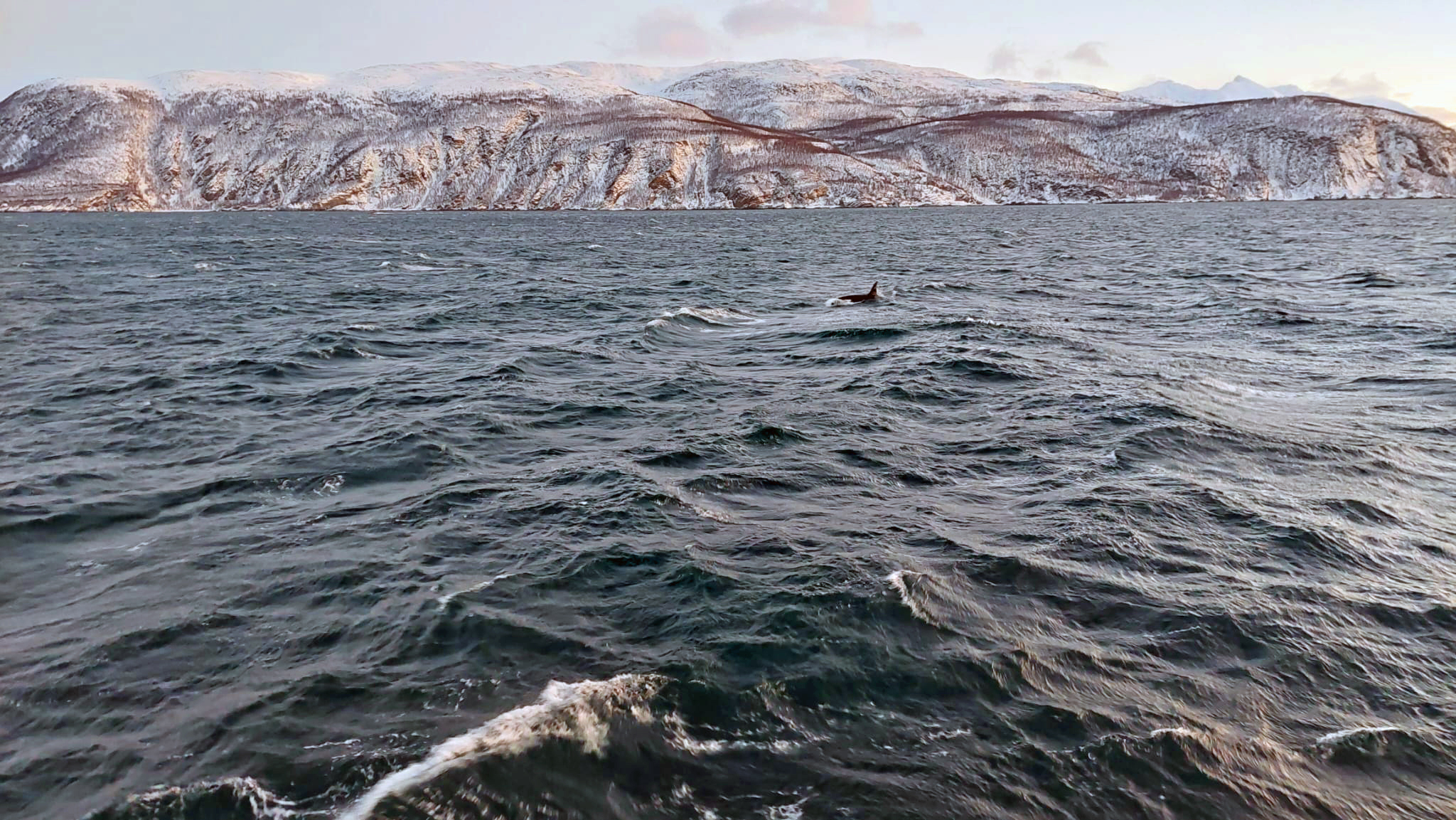
After a while the whales surface. Orcas are the most common species to see. They hunt in groups in this area during the winter months. Orcas belong to the group of whales and dolphins. They often stick their heads out of the water to see what’s going on. In Antarctica, they use this tactic to see if seals are on the ice above the water.
Orcas are very curious animals. On a boat tour you quickly notice that they swim in groups in tight circles around the boats. Orcas are very precise and selective about what they eat. Unlike humpback whales, they do not swallow fish whole, but leave the skeleton behind. In addition, the orca’s brain is five times larger than of a human. They are correspondingly intelligent and social. Orcas can also see in dark waters by clicking noises that echo in the water (like bats do in the air). In this way they can even distinguish between different types of fish.
During the information lecture at the beginning of the trip you will learn about the differences between whales and what their special movements mean.
It is not uncommon to see humpback whales. Many people also call them “Guardian Angels” because they often protect seals from orca attacks in Antarctica. They reach an impressive size and are also group animals. These animals are so graceful that they are called “Angels of the Sea” as well.
Humpback whales don’t have teeth, but baleen (which has the same material as hair). To eat, they open their mouths, catch the herrings and use their tongues to expel the excess water through the baleen, which function like sieves.
Baby whales (calves) are born in the Caribbean and initially only have a small layer of fat, which only develops over time. Without this layer of fat, the water in the north would be too cold for them.


Returning to Tromsø
After an exciting but long day, you arrive back in the harbor of Tromsø in the evening. On the way back, the guides explain some of what you saw that day and answer questions.
A few hours after leaving Kvænangen fjord, the city of Tromsø shines on the horizon. You can take spectacular shots of the illuminated city from on board. The boat also passes under one of Tromsø’s bridges, where you can also see the Arctic Cathedral.


If you are interested in receiving regular notifications when a new blog post is online, subscribe to the newsletter.
Thank you for reading this blog post! I wish you a nice day and see you soon!
Zsofia

Leave a Reply